Рубрика: Без рубрики

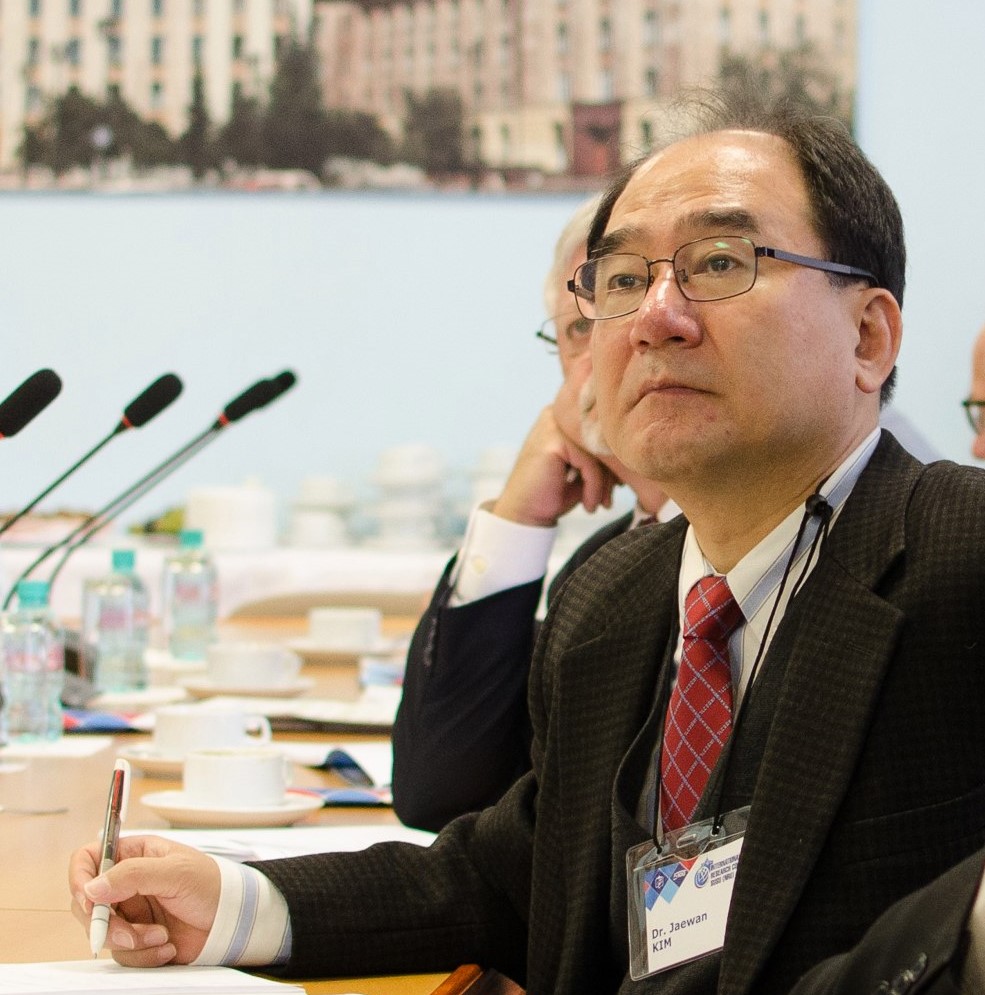
  • We invite you to a seminar by professor Jaewan Kim!

    We invite you to a seminar by professor Jaewan Kim!

    Dear colleagues!

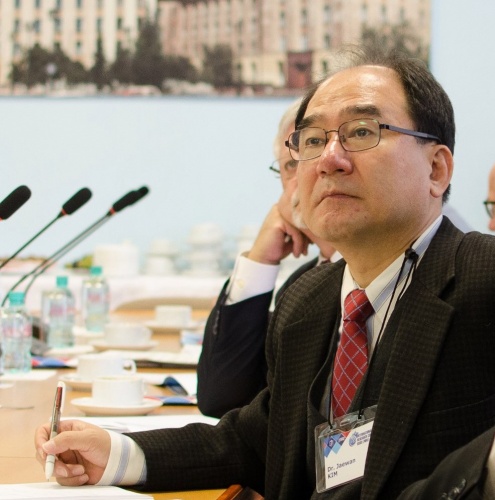
    A seminar by Prof. Jaewan Kim will take place on June 13, from 10:00 to 12:00, in room 434/3b. The topic of the seminar is: «Quantum Entanglements and Quantum Information».

    Quantum mechanics has been the major principles of 20th-century science and technology, especially for information technology. But the application of quantum mechanics has been limited to the hardware of information technology such as semiconductor devices and laser. Now quantum mechanics will govern all the aspects of information technology, not only hardware but also software and operating systems. It is called quantum information science and technology. The most important resource of quantum information science and technology is quantum entanglement. Quantum entanglement is a new type of correlation, that is provided by quantum physics and it’s cannot be mimicked by any classical means. In this talk, the brief concept and some applications of quantum entanglement will be explained such as quantum teleportation, quantum imaging, quantum cryptography, and so on.


    Prof. Jaewan Kim holds a position of vice president of the Korean Institute for Advanced Studies (KIAS).

    The main directions of his scientific activity are problems related to quantum informatics, quantum teleportation, quantum cryptography, quantum computations with respect to solving practical problems.

    We invite you to participate in the seminar!

  • PwS@PhD: International School on Software Engineering at SUSU

    PwS@PhD: International School on Software Engineering at SUSU


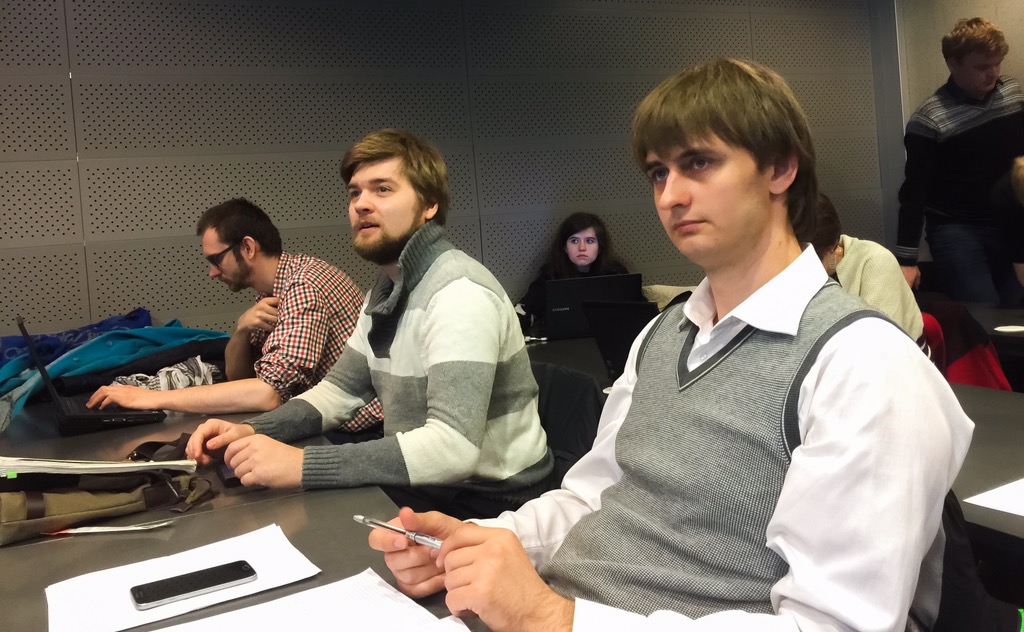
    For the first time, SUSU will become an international venue for education and the exchange of experiences in software engineering between postgrads and researchers from 6 countries and 11 universities. From May 15th through May 28th the international school on Mathematical and Computational Foundations of Program Engineering will be held at the university at the School of Electrical Engineering and Computer Science. Director of the SUSU School of Electrical Engineering and Computer Science Gleb Radchenko told us about the project’s goals, the teaching format, and the unique opportunities for young researchers

    – What is the Erasmus+ PWs@PhD International Project and what opportunities does it offer?

    – PWs@PhD is an academic project being realized within the Erasmus+ program from the European Union, aimed at the development, modernization, and internationalization of higher education and its research portion at the PhD level and support for the foundation of new PhD programs in software engineering in partner countries. 11 universities are participating in this project: Lappeenranta University of Technology (Finland), University of Rostock (Germany), The University of Central Lancashire (Great Britain), Aalborg University (Demark), The University of Jordan (Jordan), Yarmouk University (Jordan), The Jordan University of Science and Technology (Jordan), South Ural State University (Russia), Ural Federal University (Russia), and other universities. The project is totally financed by funds from the EU and gives postgraduates of partner universities a chance to gain unique experience and skills in bleeding edge methods of software engineering.

    – Why was SUSU chosen as the venue for this project?

    – SUSU is hosting this many honored representatives of the international academic society for the first time. We are one of the 11 partner universities of the international school. The project was initially thought up as a series of scientific schools in various areas of software engineering for the 2016-2018 period. Every half year a 2-week school for postgraduates for all of the partner universities is organized at one of the universities of the consortium. Our university works very closely with Lappeenranta University of Technology (LUT, Finland) in dual degree programs for a master’s in Informational Technology where many of our talented students work. And it’s natural that LUT, as the project coordinator, referred to us as one of Russia’s leading universities in information technology.
    – What meaning does this event have for the university?

    – In my opinion, this is a milestone which will move the university to a new level and gives us the unique chance to move SUSU forward within the 5-100 Project. The university will be visited by many international professors and post-graduates who will get to know SUSU’s capabilities and, in the future, we hope that they will consider our university a possible place for their continued studies or research.

    – And for participants?

    – The project gives participants an opportunity for training the new generation of young researchers and teachers in various scientific areas within software engineering. Postgraduates will gain irreplaceable experience in joint projects and conferences. Taking part in the schools organized at partner universities, postgraduates will have a unique chance to open up new research horizons in software engineering.

    – Which school activities you could highlight?

    – A whole number of interesting courses are planned within the school which both participants of the school and any interested teachers and postgraduates can attend. For example, professor Janet Read from the University of Central Lancashire (Great Britain) will be offering a course in the mathematical foundations of software user interface. Within this course, she’ll speak about a very interesting, socially-significant project tied to the development of user interfaces for children with special needs. This is a visible example of the fact that mathematics and statistics play an important role in the development of user interface even for such complex tasks. A series of lectures in informational security and cryptography will be read by professor Franck Leprevost from the University of Luxembourg. Mr. Leprevost participated in the development of standards for information security (IEEE-01363, the international standard for open key cryptography), and also acted as an expert of encryption and cryptosystems in the European parliament. From SUSU, teachers of the School of Electrical Engineering and Computer Science will be participating, offering courses on the mathematical foundations of software engineering, modern databases, and data mining methods. I myself will be offering a course in modern methods of organizing distributed computing systems.

    – What format will the international school be held in?

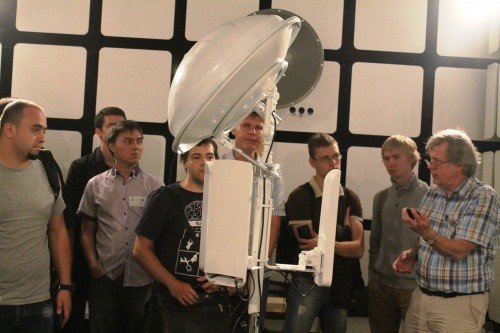
    – It is an intensive format – lectures in the first half of the day, and in the second half of the day, in the majority of courses, there will be practical lessons. Within the school, specialists invited from Ural Federal University will hold business games in self-organization and schedule planning for researchers. For guest partners, the first day of the school will be a chance to get to know SUSU, visit the international laboratories and museums at SUSU, and on the weekend there will be a packed social program – a trip around Chelyabinsk to see our sights. Also, on May 22nd there will be a trip to Yekaterinburg and Ural Federal University, where school participants will be able to get to know the leading developing companies in software engineering, including the companies Yandex and SKB-Kontur.

    – What are the planning results for holding this international school at SUSU? 

    – The final point will be an international conference on innovative methods of teaching and organizing education in information technology, the theses of which should be included in Scopus. Within the conference, here will be a presentation competition, the winners of which will receive diplomas, and all school participants will receive a certificate for their attendance. But the most important achievement is the organization of comanagement of research projects between postgraduates and professors from the partner universities of the PWs@PhD project. For example, at this time, our postgraduate student Dmitriy Savchenko is completing an internship at the Lappeenranta University of Technology, where he has already sent a scientific article for publishing in an international journal which he published with his advisor at LUT, professor Ossi Taipale. I hope that the meetings between SUSU and partners of the PWs@PhD project will allow postgraduates from partner universities to see us as a place for future productive scientific work.

    News Source: https://www.susu.ru/en/news/2017/05/12/pwsphd-software-engineering-international-level
    Oksana Kuvakina; photo by Oleg Igoshin and the SUSU School of Electrical Engineering and Computer Science
  • International Engineering School at SUSU within the Erasmus+ PWs@PhD Project

    International Engineering School at SUSU within the Erasmus+ PWs@PhD Project

    An international school, Mathematical and Computational Bases of Software Engineering, within the Erasmus+ project “PWs@PhD: Joint Programs and Framework for Doctoral Education in Software Engineering” will be held at SUSU from May 15th through 28th. More than 50 postgraduates and professors from the project’s partner-universities will attend the school. The Erasmus+ PWs@PhD project brings together 11 universities from 6 countries: Finland, Denmark, Great Britain, Jordan, Germany, and Russia. At SUSU, the project is being realized within the Higher School of Electronics and Computer Sciences.

    “This project offers a chance to train the new generation of young researchers and professors in various scientific areas of software engineering. Postgraduates will gain irreplaceable experience in working with the international scientific society by participating in joint projects and conferences. Taking part in schools organized within partner-universities, postgraduates will have the unique chance to open up broader scientific and research horizons for themselves in software engineering,” notes director of SUSU School of Electrical Engineering and Computer Science, candidate of physico-mathematical sciences, Gleb Radchenko.

    Partnership within the Erasmus+ project helps partner-countries with the development and improvement of academic programs for postgraduates and with the completion of scientific research. The foundation for cooperation is the body of knowledge in software engineering contained within the guide to software engineering (Software Engineering Body of Knowledge – SWEBOK). This project helps partner-universities adopt each other’s experiences in academics and research in software engineering, also including such areas as cloud technologies, methods for problem-oriented training, mathematical methods in software engineering, methods of informational security, organization of methods of human-machine interaction, and more.

    The Mathematical and Computational Bases of Software Engineering school is being held at South Ural State University together with Ural Federal University. From May 15th through 28th, participants will be offered courses developed by professors at SUSU and UrFU, the University of Central Lancashire (Great Britain), and the University of Luxembourg. Over two weeks, post-graduates from various countries will study the mathematical bases of software engineering, methods of organizing distributed computation systems based on microserver architecture, modern technologies for organizing data processing and storage, the basics of self-organization and data mining. A series of lectures by Franck Leprévost, professor at the University of Luxembourg, specialist in informational security, dedicated to methods of cryptography and informational security, is worth noting separately.

    “The organization of an international school in software engineering is a meaningful event for South Ural State University and for the Ural region as a whole. Meetings between professors of international universities with SUSU postgraduates and teachers and them getting to know our university’s capabilities should become the basis for developing a partnership in higher education as well as the formation international scientific research teams. Holding an event of this level, without question, increases SUSU’s prestige on the international area, which is the main goal of our university’s participation in the 5-100 Project,” notes rector of South Ural State University, doctor of technical sciences, professor Aleksandr Shestakov.

    For SUSU postgraduates, international schools in the Erasmus+ grant are a unique chance to open broader scientific research horizons in the manufacturing development and research of software engineering.

    About SUSU

    South Ural State University (a national research university) is the center of the South Ural region’s educational, scientific, cultural, and sport life. SUSU includes 9 institutes, 3 higher schools, a military training faculty, and a faculty of pre-university training. More than 40 thousand students study in university and its branches. The academic process includes more than 5000 teachers and staff, including more than 360 professors and doctors of science and 1600 candidates of science and associate professors. Bachelor’s students, master’s students, and specialists are training in more than 200 programs and specialties. In October 2015 as a result of a competitive selection, SUSU entered the group of leading Russian universities chosen for participation in the 5-100 Project, whose goal is maximizing the competitive position of its universities on the global market of academic services and research programs.

    About the Erasmus+ Project

    The Erasmus+ program is a new program of the European Union which aims to support cooperation in academics, professional training, youth, and sport, from 2014 until 2020.

    The new program is meant to become an effective instrument to facilitate the development of human and social capital in Europe and outside of its borders. The program’s goals include the creation of a new quality of cooperation, including:

    • the use, distribution, and development of previous results;
    • the promotion of new ideas and bringing in new partners from the labor and civil society spheres;
    • the creation and development of new forms of cooperation.

    11 Universities are included in the “Erasmus+ PWs@PhD” project:

    • Lapeenranta University of Technology (coordinator),
    • University of Rostock (Germany),
    • The University of Central Lancashire (Great Britain),
    • Aalborg University (Demark),
    • The University of Jordan (Jordan),
    • Yarmouk University (Jordan),
    • The Jordan University of Science and Technology (Jordan),
    • South Ural State University (Russia),
    • Ural Federal University (Russia),
    • Peter the Great St. Petersburg Polytechnic University (Russia),
    • Saint Petersburg State University (Russia).

    You can find additional information about the project on the Russian site of the project: http://eecs.susu.ru/ru/pws_phd/


    Gleb Radchenko
  • SUSU and Kaspersky Lab Launched the First Joint Research Center

    SUSU and Kaspersky Lab Launched the First Joint Research Center


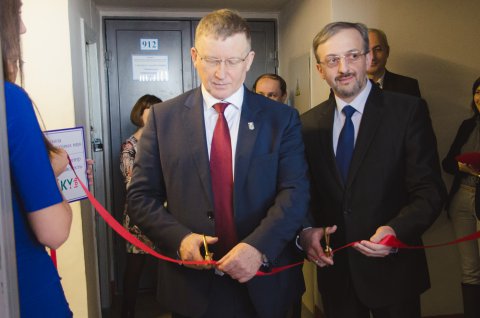
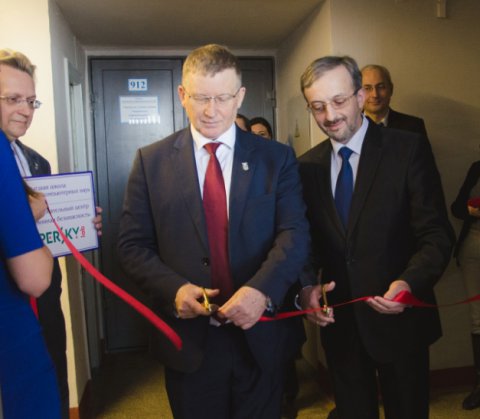
    The Research and Education Center (REC) of Kaspersky Lab «Information Security» was opened in Chelyabinsk. The REC was established on the premises of the High School of Electrical Engineering and Computer Science of SUSU.

    Kaspersky Lab is the world’s largest private company operating in the field of information security. It operates in 200 countries all over the world. The first Research and Education Center in Chelyabinsk created by the Laboratory is located on the 9th floor of one of the buildings of South Ural State University.

    According to the Rector of SUSU Alexander Shestakov, the new center will allow students of the largest university in the South Urals to better organize counteraction to emerging threats to information security and ensure the national interests of the Russian Federation in the information sphere.

    «Information security and knowledge in this field are becoming more valuable today, so for the University the foundation of such a scientific and education center is an important step. In the future, we will develop this focus area. Together with our colleagues from the Kaspersky Lab we will improve the training programs at the field-oriented Department of Information Security, and will also develop additional education. Another promising area, which we will pay special attention to, is information security in industry,» Alexander Shestakov noted at the opening ceremony of REC.

    Another important area of cooperation between SUSU and Kaspersky Lab will be research work in the field of information security at an interdisciplinary level. This will provide new tasks for all the scientific areas of the University related to information technology, radio electronics and automated control systems.

    «This year Kaspersky Lab celebrates its 20th anniversary. Over the years, we have entered the world’s top companies working in the field of information security, and have accumulated a huge amount of knowledge, which we now transfer to education and science. I am confident that over the next 20 years we will develop together with South Ural State University, one of the leading universities in the country,» said Dmitry Postelnik, head of educational programs at Kaspersky Lab, JSC.

    The Minister of Information Technology and Communication of the Chelyabinsk region Alexander Kozlov noted that the foundation of the center will provide SUSU graduates additional competitive advantages in the labor market.

    «The opening of the REC of Kaspersky Lab «Information Security» is an unprecedented event for the Chelyabinsk region in general and the University in particular. I am sure that due to this laboratory graduates of SUSU will be able to bring even more benefits both in specific industries and enterprises where information security issues need to be addressed, and in IT companies where they can create new information security tools and develop existing ones. The demand for such specialists is extremely high. This is the most demanded IT profession at the moment,» says Alexander Kozlov.

    It should also be mentioned that the partnership of South Ural State University and Kaspersky Lab provides training of specialists in the field of information security and work on joint research projects.

  • Graduate Students and Faculty of EECS SUSU Took Part in the International School of Software Engineering in Jordan University

    Graduate Students and Faculty of EECS SUSU Took Part in the International School of Software Engineering in Jordan University

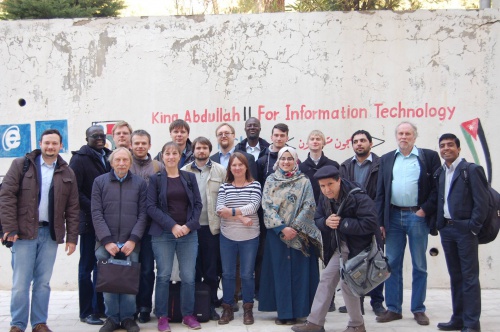
    The Jordan University (Jordan) hosted the third International Workshop on Software Engineering in the framework of Erasmus+ PWs@PhD project from February 1-st to February 12-th 2017. The school was attended by graduate students and faculty from Russia, Jordan, United Kingdom, Finland, Denmark. School of Electrical Engineering and Computer Science of the South Ural State University were presented by four representatives, including two faculty members and two postgraduate students.

    The delegation included the dean of the School of Electrical Engineering and Computer Science, Gleb Radchenko and the Assoc. professor of the system programming department Alina Latipova as well as two post-graduate students (Kirill Borodulin and Mikhail Timchenko).

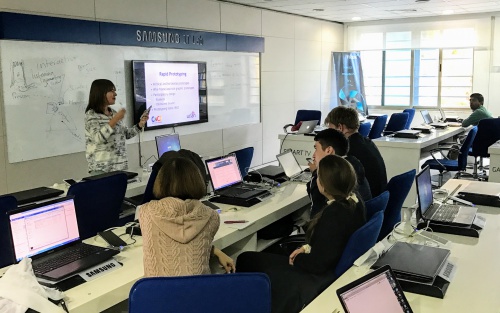
    Within the framework of the school, leading scientists from Jordan, Great Britain, and Canada provided lectures on such issues as software development, information security, requirements management, testing, service-oriented architecture, human-machine interface, and software metrics.

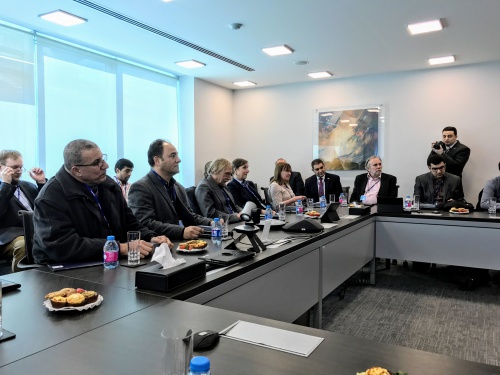
    The participants of the school could see how those modern approaches were implemented in practice at ProgressSoft company — the leading IT company in Jordan. The heads of departments told about the organization of software development and support during the tour of the company’s office.

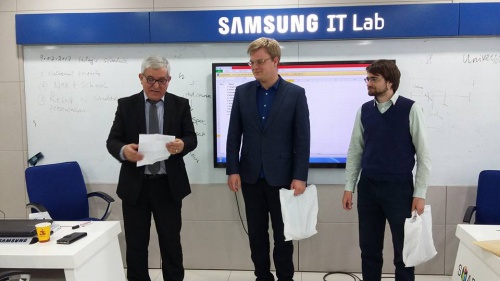
    Graduate students presented reports on their research during the school. Graduate student Kirill Borodulin took 2nd place in the contest of papers on the topic: «Planning and dispatching computing resources in containerized cloud environments». The jury noted the high level of his papers, indexed by Scopus as well as developed software.

    For Mikhail Timchenko, another graduate student of the School of Electrical Engineering and Computer Science, it was a first experience of presenting his work at the international level. His work was awarded as a confident debut. Mikhail shared his impressions with us.

    — Michael, what themes of the school do you remember most?

    There were many directions at the school. Most of all I liked the lecture of Bashar Nuseibeh, professor of the British Open University. He talked about the current trends in the development of software requirements. There was not a single person in the audience who did not understand him, the presentation of the material was simple, and his English was excellent. Professor Nuseibeh was born in Jordan, he got his degree in the UK, where he decided to continue his scientific career.
    On the last day of the school, we were given the opportunity to get acquainted with the education systems for post-graduate students in different countries. Local professors presented a modular structure for postgraduate education in the field of software engineering, which was accredited by the European Committee. During the seminar, the discussion arose about the advantages and drawbacks of each of the education systems.

    — You prepared a presentation on your scientific work at this school. How do you like your presentation?

    I am engaged in the subject of my scientific research for only six months, so there was not much practical results to present. This was my first report in English, and also it was the first by the topic of my scientific work. The reporting way of my Russian colleagues and me was strikingly different from foreign graduate students. We set out the steps of the forthcoming work and they presented an overview of the problematic issues. Each presentation was evaluated by at least three experts. It seems to me that my report was successful, although the language barrier partly prevented me from answering questions.

    — Are you going to take a part in the following schools?

    The international school will last several more years. I hope that I will be able to get into the number of its participants. I am grateful for the opportunity given and the experience gained.

    The next school will be held at the South Ural State University in May 2017. It will be devoted to modern technologies of data analysis and mathematical fundamentals of software engineering.

  • SUSU Partners with Kaspersky Lab to Establish Science and Education Centre

    SUSU Partners with Kaspersky Lab to Establish Science and Education Centre

    Chelyabinsk, March 27, 2017 – Kaspersky Lab Science and Education Center (SEC) «Information Security» is to be opened at SUSU. The Center opens on the basis of School of Electronics and Computer Science, SUSU; its work will focus on providing security of information systems, including information security of key government installations.

    “This project creates new opportunities for providing information infrastructure security to enterprises and organizations of the Ural Region. It is no secret that our region is rich in key, high-tech production enterprises of the defense sector, including Rosatom and Roscosmos. In the modern world, it is impossible to imagine the governance of such companies without the application of Internet Technology, which requires a special approach to providing the information security. Our specialists’ participation will enable companies and enterprises in the region to conduct the software audit, reveal the existent vulnerabilities, and then upgrade the system to meet the modern requirements”, – states Dmitry Postelnik, Kaspersky Lab Director for Education Programs.

    The SUSU-Kaspersky partnership aims at joint multidisciplinary research projects in the field of information security. This will set tasks to every research direction at the University related to IT, radio electronics, and industrial control systems. PhD training in the Center will help the University to educate the young generation of scientists who can conduct research into the methods and systems of information security.

    Another important direction of SUSU-Kaspersky cooperation is providing training for specialists in the field of information security. This will add impetus to the development of such disciplines as “Network Security”; “Information Security in Open Systems”; “Protection of Information in the Internet”; “Computer Virology”; and “Modeling of Information Resistance to Information Security Threats”. Apart from that, the cooperation will give the opportunity to implement a new master’s degree program “ICS Cyber Security”.

    “Kaspersky Lab Science and Education Center at SUSU offers us the possibility of developing and implementing new education programs and research. Using the best anti-virus software and analyzing ICS cyber security, we will be able to provide IT security specialist training at the world-class level”, – believes SUSU Rector Alexander Shestakov.

    These days, information technology has become ubiquitous; it is now changing every aspect of people’s lives, societies, and states. Graduates of School of Electronics and Computer Science will gain a significant competitive advantage in the job market with their knowledge of Kaspersky Lab software products.

    “For more than 14 years, South Ural State University has been offering academic programs in the field of information security. During this time, 10 classes have graduated and more than 500 specialists trained in this academic program. The special feature of Information Security specialist training has always been its practical orientation. As a result, our graduates have headed the industry. For example, Andrey Bryzgyn, our Information Security graduate, holds the position of Head of Audit and Consulting in “Group-IB” (Moscow) and he is an expert on information security on RBK TV channel. Our graduates specialize in information security in many banks in Moscow, Yekaterinburg, and Chelyabinsk. SUSU Information Security graduates head the relevant departments in government structures, FSB licensed and FSTEC licensed companies”, – notes Alexander Sokolov, Head of Department of Information Security, School of Electronics and Computer Science, SUSU.

    Kaspersky Lab Science and Education Center will enable SUSU graduates to develop news methods of resistance to the emerging information security threats and protect the national interests in the information environment.


    Kaspersky Lab is a global cybersecurity company founded in 1997. Kaspersky Lab’s deep threat intelligence and security expertise is constantly transforming into security solutions and services to protect businesses, critical infrastructure, governments and consumers around the globe. The company’s comprehensive security portfolio includes leading endpoint protection and a number of specialized security solutions and services to fight sophisticated and evolving digital threats. Over 400 million users are protected by Kaspersky Lab technologies and we help 270,000 corporate clients protect what matters most to them.

  • EECS innovative projects entered the National Technological Initiative programme

    EECS innovative projects entered the National Technological Initiative programme

    On 14-15th of March, two major innovative projects of the South Ural State University were successfully presented at the strategic session on the national technological initiative in Chelyabinsk IT-park and entered the “road map” for the implementation of the National Technological Initiative program on the territory of our region in 2017-2019.

    The event was attended by representatives of the Russian Venture Company (RVC) and the Agency for Strategic Initiatives. The session was chaired by the vice-governor of the region Ruslan Gattarov, as well as sponsored by the Ministry of Economic Development and Trade (Sergey Smolnikov), the Ministry of Information Technologies and Communications (Alexander Kozlov), the Chelyabinsk Region Industry Development Foundation (Sergey Kazakov) and the Cluster Development Foundation (Victoria Boos).

    Our university was represented by the best scientists and developers — Yuri Uzkikh, the CEO of the Regional Engineering Center of Additive and Laser Technologies with the project “development of Flexible Production Robot Systems” and the Director of the Center for Supercomputer Simulation Kirill Borodulin with the project “Digital Industrial Platform of Russia”.

    The purpose of the strategic session was to agree on a plan of measures to implement the scientific and technological initiative (STI) in the Chelyabinsk region, as well as to form a program for the development of national champions in the high-tech business of the Chelyabinsk region.

    For successful implementation of the regional policy in SUSU, a special acceleration program on STI directions has been launched, and a youth business incubator is operating. For the development of entrepreneurial culture in the region, the concept of the STI Competence Center was built up on the basis of our university.

    The experience of the past year showed that SUSU innovative projects, created as a part of the national technological initiative, can receive decent financial support. So, in December 2016, a project of scientists from SUSU “Prototype development of hardware and software complex for model-pro-active energy consumption control on the concept of distributed energy conservation plant” (OOO NPP “Polytech-Automatics”) under the guidance of Tatiana Barbasova, the candidate of tech.sc., was highly appreciated and received funding of 20 million rubles. Currently, the university is working on more than 20 similar innovative projects that are ready for representation at the Federal level.

    The outcome of the session was the discussion of support provided by the Regional government for the presented innovative projects and strategic planning of the regional “road map” for the implementation of the National Technological Initiative program on the territory of the Chelyabinsk region in 2017-2019. The actions of the strategic initiative “Innovative Leadership in the Regional Development” of SUSU academic excellence program were reflected in it.

  • Graduate Students and Faculty of EECS SUSU Took Part in the International School of Software Engineering in Lappeenranta University of Technology

    Graduate Students and Faculty of EECS SUSU Took Part in the International School of Software Engineering in Lappeenranta University of Technology

    Lappeenranta University of Technology (Finland) hosted the first International Workshop on Software Engineering in the framework of Erasmus+ PWs@PhD project from April 17 to May 1, 2016. The school was attended by more than 50 graduate students and 12 staff members of universities of 6 countries, including 6 representatives of EECS SUSU.
    (далее…)

  • EECS SUSU Invites to Master Degree Programs for English-speaking Students!

    [siteorigin_widget class=»SiteOrigin_Widget_Image_Widget»][/siteorigin_widget]

    School of Electronic Engineering and Computer Science of South Ural State University invites English-speaking students to enroll in the Master degree programmes taught in English:

    Within these programmes, you would learn database administration and management, Big Data processing, IoT infrastructure design, cloud and mobile technologies for the development of IoT solutions and much more!